Sunday, June 9, 2013

Emu Kheema! Good Luck Cafe - Review

A Vegetarian is a person who doesn’t eat meat and a Non-Vegetarian is a person who does. That is how I see it. I can never understand people who claim to love or require a hefty quantity of meat every week but still balk at the idea of having anything except chicken and mutton. As for me, if there is something exotic, I want to try it!

Good Luck CafeLiterally months having passed since I had snake meat soup in Taiwan, when Mr. GP told me that Emu meat is now available in Mumbai I had to have it! So on one overcast Saturday evening, Mr. GP and I headed to the old Iranian Good Luck Cafe in Bandra West (Mumbai). The place is pretty easy to find and only a short autorikshaw ride away from the Bandra station. Mehboob studio opposite the cafe is a well known landmark in the area.

The Emu !
DSC00060We wasted no time and immediately ordered Emu Kheema which was no surprise at all and we were served in a jiffy. Apart from being slightly lighter in colour it looked no different than regular mutton kheema and we were disappointed moments later to find out that it tasted the same too! On take the first few bites we both thought it might just be mutton but soon we realised that it leaves a different aftertaste and has a stronger smell. However, Kheema seems to be a poor choice of dish to exhibit the qualities of this meat unless the point being made was that it isn't really very different from mutton because all in all we didn’t feel like we were having something different and exotic.

Chicken Biryani !
DSC00064Though the Rs. 100 emu kheema is more costly than a usual plate of kheema, the quantity is nowhere enough to be filling for anybody and we went on to order the Chicken Tikka Biryani since the cafe does not offer any other emu meat dishes. The Chicken Biryani was rather satisfying, fragrant and the chikken tikka in it weren’t burnt or overdone in anyway. It was enjoyable enough but I have tendency to get annoyed with places that do not serve raita along with the Biryani by default. Also, as Mr. GP rightly pointed out to me, the Biryani was slightly less spicy than it is at other eateries and we would have enjoyed more, a slightly spicier version.

Irani Chai !
Any true Mumbaikar knows that it is blasphemy to leave an Iranian Cafe without having the chai so we ordered “broom maska and chai” as the last course in our dinner. They served us ‘bun maska’ (on being asked they claimed kadak pav is available only in the mornings) and tea in paper cups! Why they serve tea in paper cups to customers dining inside the restaurant is beyond me but the quality made up for the lack of presentation and I had another cup before leaving.


The Emus are from Gujarat !
Right outside the cafe is this huge board advertising the main attraction, “Emu Kheema”. The claim is that Emu meat is 98% fat free and thus healthier than other meats. Interestingly enough, it is advertised as ‘red meat’, and not ‘poultry’ as I imagined it would be. On talking to the person at the counter, I learnt that their supplier runs an emu farm with 40000 birds in Gujarat! Gujarat, the land of vegetarianism of all places. Most of the meat is sent abroad and very little to Mumbai I was told. He mentioned about it being expensive at Rs. 600 a kilo for him perhaps as an explanation for the tiny quantity they serve.
I hope some Infocity entrepreneur, Gandhinagar makes good use of this locally available meat to relieve the craving of meat hungry GNLUites.

The cafe is very clean, spacious, well lit and modern looking meaning that it is more of a middle range restaurant than the stereo typical Irani Cafe in Mumbai. So if you are looking for that kind of rickety wooden seating then this is not it. We saw at least three four families who had come for dinner apart from the usual Irani cafe crowd of men looking for special chai.

There were many more tasty looking items (such as Chicken Shawarma) on the Good Luck Cafe menu that we didn’t try. At the end of the day, despite the underwhelming emu, it was a satisfying meal which cost us less than Rs. 200 per head. I wouldn’t go there again or recommend anyone to go there just for the emu unless the come up with items like emu tikka which shall let us appreciate the meat better than kheema.


Sunday, February 3, 2013

Top 5 Constitution Articles that baffle me (and probably you!)

It is trend. In first semester when I was supposed to be studying Torts, I used to feel like reading Public International Law. Then when I was doing a PIL moot I felt like reading landmark Constitutional Law judgements. When it was the deadline for moot memo submission neared, I spent a great amount of time reading about a by-election in Singapore and other random things. Tonight, when I am supposed to be reading WTO Panel reports and other material for, I am actually flipping through a (borrowed) Constitution Bare Act.
I know, I should totally be looking through Seervai and other treatises on Constitution to find out true intention behind the introduction of the following Articles in the Constitution of India but then blogging about this is easier. Here are the Articles that baffle and hopefully, someone can enlighten.
  • Article 290A
    A sum of forty-six lakhs and fifty thousands rupees shall be charged on, and paid out of the Consolidated Fund of the State of Kerala every year to the Travancore Devaswom Fund; and a sum of thirteen lakhs and fifty thousand rupees shall be charged on, and paid out of the Consolidated Fund of the State of Tamil Nadu, every year to the Devaswom Fund established in that State for the maintenance of Hindu temples and shrines in the territories transferred to that State on the 1st day of November, 1956, from the State of Travancore-Cochin.
    Transferring taxpayer funds to temples directly? What happened to being a secular republic? What is it all about? I am guessing it is some concession made to princely ruler of Travancore to get him to accede to the Union but it is still just absurd. Why Indira Gandhi didn’t get rid of this along with the Privy Purses is beyond me.
  • Article 371E
    Parliament may by law provide for the establishment of a University in the State of Andhra Pradesh
    Hello dear MPs! Didn’t it occur to you that you could directly pass an Act to that effect rather than making a provision in the constitution? I suspect they were just being lazy and instead of actually drafting a law (which presumably shall be a very long, detailed act), they just threw in a one liner into the Constitution via the 32nd Amendment.
    If constitution articles have feelings, this one must be feeling pointedly neglected and ignored especially since several volumes of books, endless debates and even agitations have taken place over its nearby neighbour, Article 370, while nobody cares about this one.
  • Article 273
    (1) There shall be charged on the Consolidated Fund of India in each year as grants-in-  aid of the revenues of the States of Assam, Bihar, Orissa and West Bengal, in lieu of assignment of any share of the net proceeds in each year of export duty on jute and jute products to those States, such sums as may be prescribed.(2) The sums so prescribed shall continue to be charged on the Consolidated Fund of India so long as any export duty on jute or jute products continues to be levied by the Government of India or until the expiration of ten years from the commencement of this Constitution whichever is earlier.(3) In this article, the expression "prescribed" has the same meaning as in article 270.
Firstly, I don’t really understand the purpose behind having this provision atConstituent Assembly Photograph all. Secondly, what is the status now? Is it now totally redundant since ten years have long passed? Why hasn’t any one of the hundred Constitutional Amendments repealed it?
The Constituent Assembly also used to sit as the unicameral provisional parliament, this is probably a result of one of the days when they were confused about which capacity they were sitting in! This is far from a fundamental issue and could have easily been dealt with without having an Article in the Constitution.
 
  • Article 366
Being used to finding definition clauses in the first couple of sections of any Act, I was stunned when I first saw that the Constitution has more than one Article having marginal note ‘definitions’. This is the most generic definitions Article in the Constitution and included in the 30+ clauses of the Articles are gems like -
(3) "Article" means an article of this Constitution;(16) "Part" means a Part of this Constitution;(23) "Schedule" means a Schedule to this Constitution;

  • Article 393
This Constitution may be called the Constitution of India.
393! Did you see that? 393! Undoubtedly the most simple Article, why is it not Article #1? Why leave it till much much later?
 
 Much has been said about our Constitution being the longest in the world. I do largely agree with view that there is nothing wrong with having a long constitution if it helps to make clear the provisions. However, that said, it is ridiculous how amendments have burdened the constitution with redundant and extremely context specific Articles which have no general implication.
The word ‘Constitution’ by itself gives the impression to every person that it is likely to be a document containing the most fundamental principles of governance rather than a collection of random provisions inserted to suit the need of the government and then forgotten.
There is one clause which is so specific that it applies only to one particular1987 proclamation of emergency due to breakdown in constitutional machinery of the state in Punjab.
It is high time that the constitution be rid of the many absurd, redundant provisions! I suggest that the parliament consider a “Constitutional clean up Amendment”!
If nothing else, a smaller constitution shall mean cheaper bare acts and make the law students happy! :P
Image of the Constituent Assembly is from the Wikimedia Commons.
Link -
http://en.wikipedia.org/wiki/File:Indian_Constituent_Assembly.JPG 


Tuesday, December 25, 2012

Stairs…

“In matters of climbing long staircases, how many stairs there are is not as important as how strong a will you have!”
― Mehmet Murat Ildan


IMG_20121225_175942

IMG_20121225_121750 IMG_20121225_161454

IMG_20121225_174115

IMG_20121225_173208

Hope to revive this blog from this Christmas Day! :)

Also, as you may have noticed, I have started using Instagram!

Merry Christmas!

Saturday, November 26, 2011

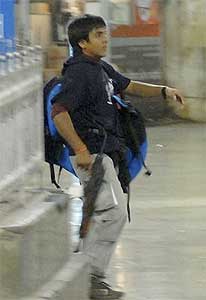
Following due process with Kasab is in your own interest!


Ajmal Kasab
Image from Wikipedia 
"Why is he still alive?"
"16 crores? Give me 16 crores instead of him"
"We have no security but he has the best security in the country"
"It has been THREE YEARS!! Justice delayed is justice denied"
Now that the third anniversary of the horrendous 26/11 attacks has dawned, many of today's conversations, be it at the watercooler, while hanging in a Bombay local, while drinking chai or in a classroom, will have the sentences mentioned above. Almost everyone shall vent out their frustration about their tax rupees (those which they absolutely had to pay after exhausting 9999 methods of avoiding tax) being used keep Kasab alive and secure, three years after he was caught. In such cases, the legal community should be pointing out how following the due process of law is the righteous way of doing justice (as opposed to Guantanamo Bay). Sadly however, many within the legal community shall be baying for Kasab's blood too. Here is my little attempt to counter the situation in order to show why following the due process of law with Kasab is in the common man's own interest.

The possibility of police complacency
If the principle is laid down that in terrorism cases such as Kasab's, the trial shall be a summary trial with relaxed rules of evidence and no appeal, the police might get complacent. Here is how - If a terrorist attack takes place again, the police will be under enormous pressure to make some arrests. In order to show that they weren't caught with their pants down, the police maybe very tempted to randomly arrest some poor guy and claim they caught a terrorist. With a summary trial, this shall become really easy and therefore tempting. Even when there is scope for thorough investigation the police maybe tempted to just make someone a scape goat if they know that they wont have to prove anything beyond a reasonable doubt.

All other Indians apart from those who were the victims have only seen Kasab on TV. They are convinced of his guilt merely because all news stories about him tally. If there were to be no thorough trials for the terrorism accused, he police would just need a good PR team to tell the country that any guy they catch is the real terrorist and their job would be done.  WHAT IF THAT SCAPEGOAT IS YOU?

Present : You say - Who cares if Kasab gets a fair trial? He is guilty as hell!
Future : Will you say - I dont want a trial even though I have been falsely implicated?

Even today there are alleged cases of shoddy investigation in terror related cases (and many more in naxal related cases). I am not saying that all police will definitely turn complacent but why create the possibility?

The progress isn't really slow
The special court proceedings are over and Kasab has been sentenced to death. His appeal has been turned down by the Bombay High Court. The matter is now before the SC. The pace with which the case is moving is not actually slow by Indian standards. Indira Gandhi's assassin was also hung only after about five years.

The Money
Well, 16 crores might be a big deal for you and me but it is not for the Union of India or the State of Maharashtra. It is a miniscule part of the budget. The government spends far far more on just paying interests on its loans to foreign banks which is also a head of spending where your tax ruppees go without benefiting you. The money is not being handed over to him. It is being spent on housing him, feeding him and for his security. You may say even one rupee is too many, but then it is the cost of doing justice. Just be secure in the knowledge that if you or I are ever undertrials, the state will still feed us and try to keep us secure as far as possible too.

In conclusion, the due process is being followed and justice shall be done. There is no point in hollering for Kasab to be hung instantly. When due process is followed with him, it prevents complacency and is thus in our own interest. Furthermore, we can show the world that even terrorism can be dealt with in a humane and a fair manner without resorting to unconstitutional prisons and murders.

***
This post was first posted on Legally India website

Monday, September 19, 2011

The Great Divide


The Great Divide


Nasa recently released this picture taken from the International Space Station. Perhaps for the first time in history, the subcontinent has been photographed in a single shot. It is heartbreaking to see that the political differences which divide more than 1.5 billion cricket-loving, film-loving and generally peaceloving people of the subcontinent are obvious even from space.


Much blood has been meaninglessly spilled along this border that separates people who were essentially one, less than a hundred years ago. Now with modern weapons and nuclear arsenals backing the two huge conventional forces of the two nations, any future conflict shall only be worse. No conflict, however small or large, regardless of the result leaves behind ugly scars of unforgettable human suffering.  Over the past two years I happened to have the opportunity of interacting and making friends with sons and daughters of men who fought in the shortest Indo-Pak war, the Kargil conflict (in which India emerged ‘victorious’) and these interactions have only strengthened this view.


Had there been no partition in 1947, inter alia, we would have been able to see the dream team of players like Imran Khan, Kapil Dev, Wasim Akram, Javed Miandad, and Sachin Tendulkar play alongside each other. While there is no real point in looking back at such “what if” scenarios, I do hope that at the very least, the subcontinent does not have to witness any more bloodshed over this border. 


It is sad that these days, whenever a list of the most important issues that the government needs to urgently deal with is prepared, “The Indo-Pak peace process” rarely finds a place in it. It has been assumed by much of the Indian society that the Indo-Pak ‘problem’ cannot be solved and the peace process shall never meet success. In my opinion it should be the topmost priority of any government that comes to power in either country.


A very encouraging initiative that Times of India and the Jung group of Pakistan had launched a while ago was the ‘Aman ki Asha’ campaign to encourage people to people ties between the two nations. I hope they are still continuing this unique effort. Only when the people of each country forget the militaristic nationalism encouraged by the political parties and realise how similar the cultures of the two nations are shall there be a real hope of peace and fraternity between the two.


Looking at the great divide today, I wish that I, not only not see any Indo-Pak war in my lifetime but also that I see a time when such conflict is unimaginable and the great prominent border in the picture is largely meaningless. I fervently hope this wish of mine comes true. 


SO CLOSE AND YET SO FAR...
Lahore and Amritsar : So close, yet so far!

Note: The border is prominent as an orange line in the NASA picture as a 2000km section of the border has been fenced and also floodlit by the Indian government to stop militants from infiltrating into India.