Showing posts with label India. Show all posts

Monday, August 26, 2019

Transactions in India - truly SIMPLE!

Earlier this year, this tweet from 'Simple' the new age bank, popular amongst millenials in the United States caught my eye.


I had a good laugh. US$5 sounded like a ridiculously excessive charge for 25 cheques. Every single bank account I have ever had in India, yes even the one I had as a student with miniscule minimum balance requirement, gave me 25 cheques every quarter for no extra charge at all. Though I must admit that I have only ever used cheques to cancel them and hand them over to financial institutions, schools or employers as a means to share my bank account details. I have not yet exhausted the initial set of 25 cheques I got from my bank for my newest bank account that I opened in 2016.

This made me wonder whether anyone still uses cheques in India and if so for what purpose. My very unscientific Instagram based survey yielded the following results.


Just as I suspected, more than 65% of the respondents reported not using cheques at all in the last six months while of those who do use cheques, more than half use it for rent payments and to share bank account details using cancelled cheques. 

This prompted the question why was a new age bank in the United States offering cheques to its customers? Surely no one in the land of the silicon valley would have any use for cheques - or as they would spell it - checks, right?

Turns out that Simple's move to offer paper cheques was coupled with it discontinuing a service called 'bill pay'. A startup bank not allowing you to pay bills? Something does not appear to be quite right. Ability to pay bills online is a service which even the public sector banks in India offer despite being (in)famous for not-so-great online banking portals. The mystery was unravelled when I found out what innocuous sounding "bill pay" actually was -


I kid you not. When a customer selects "bill pay" online on a bank website or application, the bank (including until recently this new online only bank) writes a physical cheque and sends it by snail mail to billers who then presumably take that physical cheque to their own bank to deposit it.


I could not in a million years have imagined that the utilities and banks in the United States would be using a system so primitive and inefficient. However, it so appears that the entire payment ecosystem in the United States is no match for what we have in India. On Instagram, 104 of my followers reported paying bills by truly online modes (such as UPI, wallets, net banking) as opposed to just 1 who reported paying by bills by cheque.

Be it for payments to merchants or to friends, today I have atleast three digital options in India - UPI, wallets and NEFT - all of which are free to use. Further with UPI (Unified Payments Interface) the transfer is instantaneous and can be initiated quickly not only online but also at any local shop due to the now ubiquitous payment QR codes.

If I am paying a friend, I just input his/her UPI ID on my UPI app (I use GPay but my friend could be using any other), I initiate a transfer, I enter the authorisation password and that is it. Within less than five seconds I get an SMS saying that the money is deducted from my bank account and my friend gets an SMS saying it is deposited into his/her. Though I feel silly typing this out, I just want to emphasise that instant in India really does mean instant.

Compare this with Venmo, which arguably is the most popular payment tool in the United States. While Venmo to Venmo payments are instantaneous, sending money from Venmo back to a bank account takes 1-3 DAYS! You would think that it is a great development then that this August, Venmo has started offering an 'Instant Transfer' option ...


...but "instant" for Venmo means thirty minutes and for that privilege you need to pay Venmo a massive 1% fee which seems absolutely ridiculous to my Indian brain used to truly instantaneous and free transfers.

Infact, with the tremendous competition between UPI service providers like GPay, and PhonePe, the Indian consumer is spoilt for choice with not just free transfers but expectations of cashbacks. While there are many fair criticisms of venture capital funded cashbacks, the basic premise that the user should be rewarded for using a digital payment method rather than an administratively cumbersome cheque or MDR heavy debit card or credit card, is a sound one.

I also hear from my friends living in the United States that merchants or outlets accepting digital payments such as Venmo are nowhere as ubiquitous as in India (or atleast Mumbai) where nearly every shop and restaurant has a QR code allowing UPI users to scan and pay directly from their own bank account to the merchant's bank account.

So it is time now to add 'great payment systems' to the list of awesome things in India that are unheard of in the United States (other items on the list are water in the toilet and requiring a permit to buy a handgun).

---

Parting thoughts 
1. While UPI will never kill the credit card because it does not offer credit, it is entirely likely that UPI may make debit cards obsolete. If this State Bank of India initiative succeeds I think other banks could follow soon.

2. I hope NPCI takes Rahul Matthan's advice and makes UPI international. Not only will it be able to provide truly instant transfers to the Americans, it would have the added advantage of stopping Facebook's Libra in its tracks.

3. The simplest justification for the United States not having sophisticated digital payments systems is that nobody there wants to pay using anything other than physical plastic credit cards / debit cards. But even for cards, the systems used in the United States are incredibly primitive. See this video for a simple explanation.

Saturday, May 13, 2017

Has the ICJ really stayed Kulbhushan Jadhav's death sentence?

2345 hours 9th May. I had just enjoyed watching Kolkatta Knightriders fail to chase a total of 167 against Kings XI Punjab and keeping Punjab's qualification hopes alive. Pleased that the form of the second placed Knightriders was faltering, I was about to go to bed as a happy Mumbai Indians fan secure in the knowledge that our top spot was not under threat. 

Just as I went through with my bed time ritual of scrolling through my twitter timeline for the last time in the day, I was startled by this tweet of Sushma Swaraj, India's Cabinet Minister for External Affairs, posted just after mid-night:


Minutes later, online news websites in India had reported the news -


While the newspapers and TV newschannels followed up the next morning -

One thing that was consistent in the coverage across the Indian media was that it gave the readers / viewers the impression that the ICJ had issued a 'stay order'.

In contrast, Pakistani media reports mentioned the filing of the petition but no mention was made of any stay order. Dawn went with the headline "India moves International Court of Justice against Jadhav's conviction" while The Express Tribune said "India petitions ICJ for stay in Kulbhushan Jadhav’s death sentence". Daily Pakistan Global even asserted that the Indian claim was false:

In turn ScoopWhoop in India published an article claiming that the Pakistani media was 'in denial of the stay on Jadhav's execution'. 

While there are assertions aplenty from both sides, nobody has really tried to answer the question of whether or not a 'stay order' of the ICJ really exists.


The request for provisional measures 

India has approached the International Court of Justice alleging a violation of the Vienna Convention on Consular Relations (VCCR) to which both India and Pakistan are parties. Whenever a national of another State is arrested in the territory of a party to the VCCR, Article 36 of the VCCR requires the State to inform the consulate of the country of that arrested national, allow the consulate to meet and assist the arrested person in the criminal proceedings if he so desires. India is alleging that these provisions were not adhered to in Jadhav's case and that India was denied consular access to Jadhav.

Since Jadhav has already been convicted and sentenced to death, India also requested that the ICJ pass 'provisional measures'. Provisional measures are similar to the concept of 'interim orders' in the Indian legal regime. Previously while deciding the LaGrand case which incidentally was also about VCCR violations, the ICJ has clearly held that the 'provisional measures' are binding.


ICJ's press release summarises India's request for the provisional measures as follows:

"India therefore requests that, “pending final judgment in this case, the Court indicate:
(a) [t]hat the Government of the Islamic Republic of Pakistan take all measures necessary to ensure that Mr. Kulbhushan Sudhir Jadhav is not executed;
(b) [t]hat the Government of the Islamic Republic of Pakistan report to the Court the action it has taken in pursuance of sub-paragraph (a); and
(c) [t]hat the Government of the Islamic Republic of Pakistan ensure that no action is taken that might prejudice the rights of the Republic of India or Mr. Kulbhushan Sudhir Jadhav with respect of any decision the Court may render on the merits of the case”.

Urgent communication  

Fearing that Jadhav maybe executed before the ICJ even has an opportunity to pass provisional measures, India requested that the ICJ pass an order on provisional measures without waiting for an oral hearing. However, India making a request does not automatically mean that ICJ would make such an order without hearing Pakistan. The ICJ has instead scheduled a hearing on the request for provisional measures in front of all the judges at 10am (Hague time) on Monday 15 May 2017. ICJ is scheduled to hear from both the countries that day. If after this hearing the provisional measures were passed in India's favour, it may be accurate to say that Pakistan has been ordered to 'stay' Jadhav's hearing.

Pending the hearing, the president of the ICJ (akin to a Chief Justice of an Indian High Court or Supreme Court) has merely sent an 'urgent communication' to the Prime Minister of Pakistan. The ICJ press release regarding this urgent communication does not reproduce the contents of the the urgent communication.


This urgent communication is what Susham Swaraj mentioned in her tweet as the 'order of the President, ICJ under Article 74 Paragraph 4 of the Rules of Court' (sic). Here is how Article 74 of the Rules of the Court reads:


Article 74
1. A request for the indication of provisional measures shall have priority over all other cases.
2. The Court, if it is not sitting when the request is made, shall be convened forthwith for the purpose of proceeding to a decision on the request as a matter of urgency.

3. The Court, or the President if the Court is not sitting, shall fix a date for a hearing which will afford the parties an opportunity of being represented at it.  The Court shall receive and take into account any observations that may be presented to it before the closure of the oral proceedings.

4. Pending the meeting of the Court, the President may call upon the parties to act in such a way as will enable any order the Court may make on the request for provisional measures to have its appropriate effects.

While the words "act in such a way as will enable any order the Court may make on the request for provisional measures to have its appropriate effects" suggest that the President of the ICJ in his communication must have asked the Pakistan government to maintain status quo, the fact that these are preceded by the words "may call upon the parties" suggests that the 'urgent communication' is not in the nature of an order but merely a suggestion or a request as there is no language stating that the communication is binding.

European Journal of International Law blog has pointed out that while  such a communication could be seen to be similar to provisional 'holding requests' of ICSID tribunals which have been held to be binding, the crucial difference is that the ICSID holding requests are passed by the entire tribunal while the ICJ urgent communication is by the President acting alone. 

Thus it seems that the Pakistani media has been accurate about there being no 'stay order' per se in this case while Indian media has gotten carried away.


Precedents

Many congratulatory posts on Twitter by Indians show that the ordinary Indians have high hopes of a favourable outcome for Jadhav from this proceedings. However, if the previous three cases of Paraguay v. United States, LaGrand case (Germany v. United States) and Avena case (Mexico v. United States) are anything to go by, there exists a possibility that Jadhav may be executed regardless of the decision of the ICJ.

Read more about these precedents in my scroll.in piece here - A short history of India vs Pakistan cases at the International Court of Justice  - Despite the headline, that piece does cover other non India-Pakistan VCCR cases as well.

I have also in the past written for scroll.in about all the India-Pakistan international adjudication cases in greater detail here - Five previous India-Pakistan disputes that have been taken to international forums

Monday, May 1, 2017

I told you so!

Though I do not blog very often, this blog is now more than six years old and it is time for some reflection on the couple of things that I got right.

In 2013 when the then central government came up with a bank which was supposedly exclusively for women, I wrote this blogpost titled - ‘Bhartiya Mahila Bank - A Misguided and Pointless Endeavour’.

Bhartiya Mahila Bank was inaugurated with much fanfare in 2013 with Sonia Gandhi handing account opening documents to the first customers and the then Prime Minister in attendance. Media reports of the time indicated bank’s ambitious plans of 25 branches in the first year and 75 more every following year..
In 2017 my words have come true and the Bhartiya Mahila Bank has was merged with State Bank of India on 1 April 2017 along with the SBI Associate Banks. The merger has finally ended the central government's first and thankfully the only experiment with a government promoted bank (all other PSUs were nationalised rather set up afresh). Bhartiya Mahila Bank never really promoted itself like other new private banks did and reports indicate that it had significant trouble getting new business. It also also remained headless from August 2015 onward when Usha Ananthasubramnian, the bank's former CMD was appointed as the CMD of Punjab National Bank. At the time of merger, it only had 103 branches which is a far cry from the stated expansion plans at the time of its innaugural.

Outlook has mentioned SBI clearly stating that the business of BMB was insiginificant:
On the merger, the SBI said that although the addition of 103 branches of the BMB and business of approximately Rs 2,000 crore will not have a significant bearing on the SBI, it will be ensured the merger strengthens and reinforces the focus on financing of women entrepreneurs.
Approximately 2,000 crore is also State Bank of India being generous and other reports have pointed out that the special bank for women had total business of only 1,600 crore rupees. While SBI opened its first all women employees branch in 2013, the same year that Bhartiya Mahila Bank was set up, by 2017, SBI already had 126 all women employee branches whereas the Bhartiya Mahila Bank had managed only 7. It couldn’t be clear that women can be served better by State Bank of India.
I had ended the my blogpost with the following words:
“The Mahila Bank is hence a solution that no one was asking for and also one that is likely to worsen the problem which it set out solve. When the question is asked a few years from now “What did the Mahila Bank achieve?”, the government is not going to have any answer.”
Let’s hope that the government has learnt its lesson and does something actually meaningful to improve women’s lives rather than going ahead with half baked segregationist policies.

Sunday, August 7, 2016

Time to reform Rajya Sabha election process

This article was first published on GNLU's only student run online magazine - Jury's Out.
In May 2014, the BJP won a historic victory in the general elections and managed to secure a single party majority in the Lok Sabha, a feat which hadn’t taken place for atleast the two preceding decades. However, despite the overwhelming majority of BJP’s National Democratic Alliance in the Lok Sabha, the government has not been able to achieve some of its major legislative objectives such as passing the Goods and Services Tax Act, because India’s bicameral legislative system requires any bill to pass not just the Lok Sabha but Rajya Sabha (the House of States), as well. Despite its poor showing in the 2014 general election Congress remained the single largest party in the Rajya Sabha and along with the other parties could muster enough votes to block government bills.
Thus, when elections were held for 57 Rajya Sabha seats earlier in June this year, one would have expected keenly contested polls with each side hoping to maximise their numbers.
However, this could not be further from the truth. Of the 57 MPs chosen, 30 i.e. more than half were elected unopposed from eight states. Even in the states where elections were conducted, most states had just one more candidate than the number of seats up for grabs. In Uttar Pradesh for example, there were 12 candidates vying for 11 seats which is in stark contrast to the 2012 legislative assembly elections in Uttar Pradesh. In those elections there were 6839 candidates contesting for just 403 constituencies and not a single constituency had less than 6 candidates in the fray.
The reason for the apparent apathy with regard to the Rajya Sabha elections is because the Rajya Sabha MPs are elected by the Members of the Legislative Assembly of each state using the single transferable vote system. Since the parties know how many MLAs they have in each assembly they are content to divide up the Rajya Sabha seats in the same proportion rather than putting up candidates and vying to get other party MLAs’ support as well.
This has led to a situation where any party leader can get elected to the Rajya Sabha regardless of his relationship with the state he is contesting from. In the present round of elections, Railway Minister Suresh Prabhu whose entire political career has been from Maharashtra, has been elected unopposed from Andhra Pradesh. Another minister, Venkaiha Naidu is from Andhra Pradesh but previously represented Karnataka in the Rajya Sabha and has just been elected from Rajasthan in 2016. Similarly, veteran lawyer Ram Jethmalani who has spent his entire career in Mumbai or Delhi has been elected unopposed from Bihar on an RJD ticket, a party he just joined.

The use of Rajya Sabha by political parties in this manner completely defeats the original intention of the framers of the Constitution. They intended that MLAs would send local leaders to the Upper House to represent the view of the state while debating central legislation.
The obvious question that arises is that; why don’t local MLAs refuse to vote for outsiders parachuted in by the party high command. With the possibility of a local rebellion the party big wigs would have hesitated from putting up candidates with no local background. In 2003, the Parliament amended the Representation of People’s Act to base the Rajya Sabha elections on an open ballot system rather than closed or secret ballot. This means that the way each MLA votes is now public knowledge and any MLA voting in defiance of the party whip can face action from the party as the Janta Dal (Secular) MLAs are finding out in this election cycle.

Furthermore, the same amendment also removed the requirement that a candidate for Rajya Sabha elections be an elector in the State which he seeks to represent. Though prior to 2003, some MPs did anyway represent states they did not have any relation to, the most prominent example being former PM Manmohan Singh as a Rajya Sabha MP from Assam, yet this requirement at least tried to ensure that the Rajya Sabha representatives be from the State they represent. Following the removal of this provision, the abuse has only grown. The interests of the people of the states they are supposed to represent have been sacrificed to make Rajya Sabha an avenue for political parties to get their senior and/or unelectable leaders into the Parliament, real quick.
If we truly desire that Rajya Sabha serve the purpose of giving states a voice in the affairs of the Centre it would be prudent to overhaul the system of Rajya Sabha elections. Step one should be the roll back of the 2003 amendments. Following that, India would be wise to consider a complete overhaul in the days to come. Strict residence requirements for candidates, direct elections with the state divided up into larger constituencies or even whole state as one constituency (similar to Senate elections in the US) are all ideas which may give results more in line with the intended purpose of the Rajya Sabha.


Saturday, April 23, 2016

Lansdowne

Last summer I went to Lansdowne, the beautiful hill station in Uttarakhand and absolutely loved it. I have written a travelogue of this visit for the GNLU magazine, Jury’s Out. Check it out here - https://jurysoutblog.wordpress.com/2016/03/28/lansdowne-an-eco-friendly-military-town/


It was very pleasant even in the summer. I strongly recommend it to anyone planning a summer trip!

Friday, June 19, 2015

Ordinance Finally Brings Clarity regarding Cheque Bounce Cases

Section 138 of the Negotiable Instruments Act, 1881 contains the offence of ‘dishonour of cheque’, commonly known as ‘cheque bouncing’. Though it is one of the most commonly used provisions of criminal law in India – in several court complexes there is a designated courtroom dealing with only section 138 cases all year round – yet there has been great confusion regarding the jurisdiction of courts in these cases which the government sought to settle once and for all by promulgating the NegotiableInstruments (Amendment) Ordinance, 2015.

Section 138 lays down that the person who receives a cheque which bounces when presented for payment can approach a magistrate for bringing criminal action against the drawer of the cheque if the cheque amount is not paid within 15 days of giving a notice to the drawer.

The Multiple jurisdictions system and its problems
For several years, the victim who received a cheque which bounced had the freedom to lodge a complaint before either the magistrate in whose jurisdiction the collecting bank (bank branch where cheque was presented for payment) is located or with the magistrate in whose jurisdiction the drawee bank (bank branch in which accused has an account and on which the cheque is drawn) is located or even the magistrate of the place from where the notice was issued. Infact the 1999 Supreme Court judgement (K Bhaskaran v. Sankaran Vaidhyan Balan) regarding jurisdiction in such matters was so broad that there could even be five possible jurisdictions based on where each of the five elements of the offence is committed. This often led to abuse of the system where complainants presented the cheques in faraway places or issued notices from cities with no link to the transaction just so that they could file the complaint from these third cities.

Supreme Court changes course
However, the Supreme Court upset the existing status quo when in Dashrath Rupsingh Rathod v. State of Maharashtra, it held that the offence was committed only when the cheque was returned by the drawee bank for the lack of funds and thus only the magistrate of the place where the drawee bank is located had the jurisdiction to hear the case. This now meant that if a cheque drawn on a bank branch in Srinagar was given to a person living in Chennai and it bounced when presented it for payment at a bank branch in Chennai, the victim shall have to travel all the way from Chennai to Srinagar to file a case. This is because the offence is committed when the bank in Srinagar returns the cheque for lack of funds and not before that.

Problems Galore
The Dashrath Rupsingh Rathod decision of the Supreme Court meant that lakhs of cases had to be transferred to other courts or withdrawn to be filed again. Further complications were added because many banks now issue cheques that are ‘payable at par’. When presented for payment, these cheques are processed not by the bank branch on which they are drawn but by the same bank’s branch closer to where the cheque is presented for payment. The Supreme Court had not clarified where exactly the offence is deemed to be committed and where the jurisdiction shall lie in such cases.

The Ordinance Fix
The ordinance promulgated by the President on Tuesday again changes the jurisdiction in cheque bounce matters by adding section 142(2) –
(2) The offence under Section 138 shall be inquired into and tried only by a court within whose local jurisdiction the bank branch of the payee, where the payee presents the cheque for payment, is situated
 As per the ordinance, the local court within whose jurisdiction the cheque is presented for payment shall have jurisdiction over the matter meaning that if you issue a cheque drawn on a bank in Srinagar and give it to someone who presents it to his bank branch in Chennai for deposit in his account, only the courts of Chennai shall have jurisdiction. In the past, in cases of multiple cheque bouncing, some complainants used to present the various cheques which they held in different places in order to harass the accused by have commencing criminal proceedings in various different cities. However, the new ordinance puts an end to such harassment by making it clear in section 142A(2) that once one cases is filed in one court, for all the future cheque bounce instances between the complainant and the accused, the same court shall have jurisdiction regardless of where the cheques are presented for payment by the complainant.

 The ordinance shall once again prompt large scale transfers of cases, however by incorporating a clause pertaining to jurisdiction within the Act itself, it eliminates the possibility of future conflicting decisions of the courts on this issue. Furthermore, by prohibiting complainants from approaching more than one court in respect of several cheques of a single person, it also adequately takes care of the interests of the accused and thus must be seen as a positive step.


 Recourse to the ordinance route was necessitated because though the Lok Sabha passed an identical Bill in the previous session of the Parliament, it could not be taken up in the Rajya Sabha due to the lack of time. It is imperative that both houses approve the Bill to replace the ordinance in the next session because allowing the ordinance to lapse would plunge the system back into a chaotic state.

Tuesday, February 10, 2015

The Real Heroes Of The Republic Day Parade

--- 
This post was first published at Huffington Post India on 04/02/2015.
 ---

2015-01-30-IMG_20150125_154355.jpg
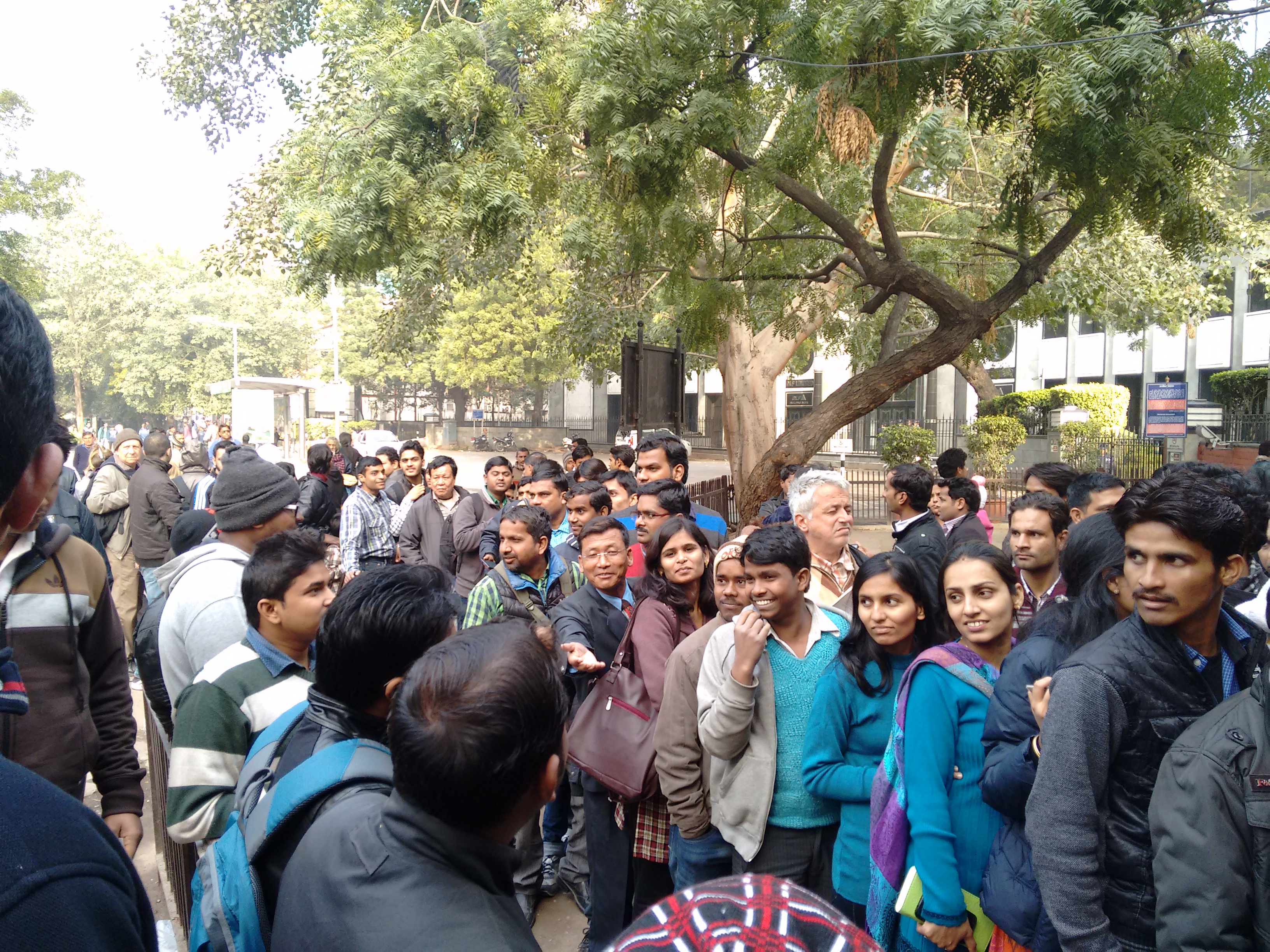
Doordarshan's Republic Day Parade broadcast gave us much background information regarding our gallantry award winners but it forgot to focus on some other heroes at Rajpath - the viewing public who managed the awe-inspiring feat of procuring the parade tickets. Here's the story of what it takes to make it to Rajpath on 26 January.

Having a quiz to attend in Delhi on 22 and 23 January, I spotted an opportunity to extend my stay and watch the Republic Day Parade live at Rajpath. When I asked around for the procedure to get a ticket, I soon realised that the only advice that everyone (even the otherwise loquacious breed of Delhiites) had was to get a pass by contacting influential bureaucrats. I was often told, "Ticket line se nahi, pehchan se milti hai (You get tickets not from a queue but through contacts)."
Though I discreetly enquired of my friends if they knew these pass-bearing influential persons, I refused to believe that this underhanded method could be the only feasible way to obtain passes. I searched the internet to find out how I could lay my hands on the tickets being sold to the public at large.
The Press Information Bureau had no useful release regarding the sale of 2015 R-Day Parade tickets. The only available press release merely stated that tickets are still available at the "designated sale counters" without any mention of where these were.Media articles were just as vague.
Finally I thought I had struck gold when I found a 2007 press release detailing the locations where the tickets were available. However, when I turned up at the Gandhi Ashram in Chandni Chowk (which isn't really an ashram at all but a khadi store) I was told that the press release I was relying upon was hopelessly outdated and that no tickets were available there. The store attendants suggested that we go to the government's tourist office at 88 Janpath.
Having wasted my time once, I decided to call the tourist office at Janpath only to discover that the Delhi Tourism website lists only a seven-digit phone number for its Janpath office which is obviously an incomplete number and cannot be dialled.
Hearing from a friend that tickets are usually available at Parliament House, I dialled the reception where the very helpful receptionist explained to me that the Ministry of Defence personnel selling the tickets had shut shop and left an hour early as 23 January was the last day of sale there.
Hearing my side of this phone conversation, a helpful aam admi on the metro informed me that tickets were being sold at Pragati Maidan. Upon reaching Pragati Maidan Gate No. 1 the next afternoon (after being thoroughly fleeced by auto drivers) I was delighted to at least see a ticket sale counter in existence. The joy was short lived though, since the official manning the counter told me that the daily quota of Republic Day parade tickets was sold out and that I could only buy tickets for the Beating Retreat programme. He asked me to return at 8am the next morning (25 January) to buy the coveted Rs 300 tickets which apparently give one the right to reserved seating. What I did not know was that he had left out some key details.
The next morning, I braved the freezing weather (at least to my Mumbai body) and made it to the Pragati Maidan counter at 8.15am only to find a long queue of at least 50 well-equipped ticket seekers laughing at the sorry figure I cut. I had neither a warm jacket or hat nor the required documentation. The kind souls in the queue told me that the guy at the counter was issuing the reserved tickets only to those who had a photocopy of an identity card. So I walked for 1 ½ km each way and returned with a photocopy of my driving license. It was 9am by then and the counter was still not open. While I was wondering why the person at the counter didn't tell me the ID card requirement the previous day, the people around me had even more surprising details to share. On an average it was the second or third purchase attempt for everybody in the line. I was also told that even upon having ID, a person could buy only one reserved ticket meaning that I would not be able to purchase any for my quiz partners who were patriotic enough to want to watch the Parade live but not enough to go hunting for tickets.
While we were waiting for the counter to open, Delhi Traffic Police and CRPF personnel made their appearance in large numbers and briskly informed us that the counter would not open until 1pm and that we had to clear the area in an hour. When half an hour passed without anyone believing the police, the cops could be heard murmuring to anyone who asked them "Please chale jiye warna danda marke bhagana padega (Please leave otherwise we may have to chase you away with sticks)."

When clearing the sidewalks of the road which the American President plans to take to Raj Ghat takes precedence over selling Republic Day tickets to patriotic Indians, that is the point when you realise how apt the tourism slogan is. India is truly incredible.
Upon the police officer's suggestion, I decided to try my luck at Jantar Mantar where apparently the second of these mysterious ticket sale counters was located. I stopped enroute in Connaught Place to grab brunch and buy a sweater. The mission to acquire tickets was taking significantly longer than I expected it to.
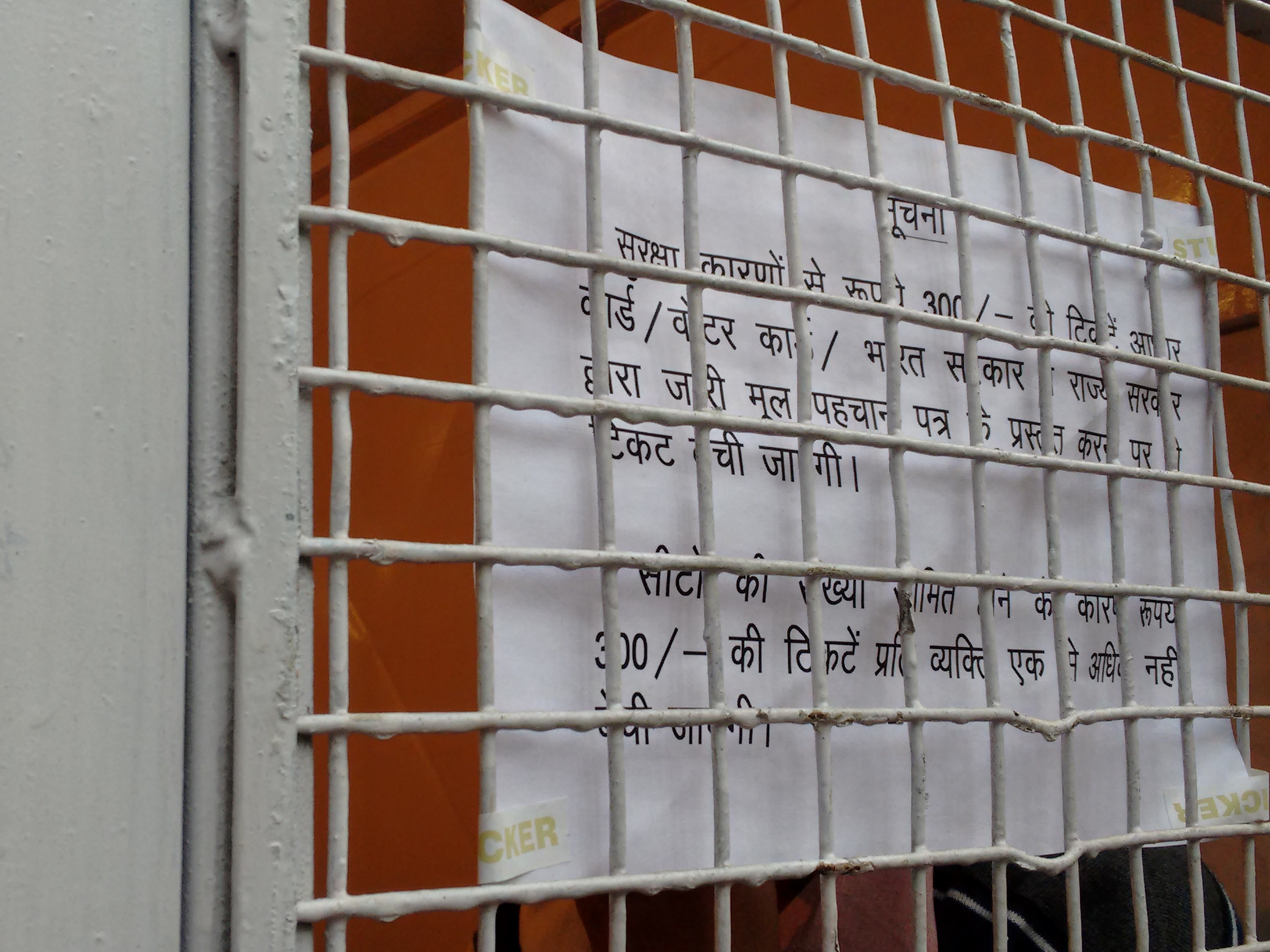
As I walked towards Jantar Mantar, I could barely see its entrance or the ticket counter. All I could see was a mass of humanity, certainly numbering in the hundreds, in what might (or might not) pass for a queue. I dutifully joined it. However after the queue did not move for a few minutes, I decided to investigate. I was surprised to discover that a couple of hundred people had been queuing for two hours on the vague promise that more tickets might arrive soon. I was wondering whether to join this hopeful exercise when the Indian bureaucracy threw its final and fatal hurdle in my path. At the counter there was a small notice which stated, "Only Aadhaar Card and Election Card shall be accepted as ID proof." Since the only identity document that I was carrying to Delhi was a driving license, I finally admitted defeat in the face of these arbitrary and ever-changing ticket requirements.
I am trying to convince myself that I did not miss much since the gods literally rained on our parade. However, I can't shake of the feeling that a celebration to commemorate the day when we adopted the ideal of equality as a nation should not just be available to the elite with contacts. The ticket sale process definitely needs to be made transparent and publicised, if not reformed and opened to people apart from Delhiites with enough free time to decipher the maze of designated counters.
2015-01-30-IMG_20150125_154241.jpg


2015-01-30-IMG_20150125_154327.jpg

Tuesday, February 3, 2015

Of Suicides and Protests

---
This post was first published at Huffington Post India on 18/12/2015.
---

The Minister of State for Home Affairs, Haribhai Parathibhai Chaudhary announced in the Parliament on Wednesday that the central government is planning to give effect to the 210th Report of the Law Commission of India by decriminalising 'attempt to commit suicide'. This decision shall undoubtedly be controversial since many believe that section 309 of the Indian Penal Code which criminalises 'attempt to commit suicide' is infact a provision that helps to uphold the dignity of life since it discourages taking of one's own life. While there already are debates raging regarding the morality of the move, the ramifications of the move on the culture of suicides during agitations and protests in India seem to have been ignored.

Hungerstrikes and Self Immolations
Ever since the pre-independence era, a 'fast-onto-death' has been a popular tool of protesting government actions and demanding a roll back. More violent protesters have also adopted the method of attempting self-immolation to draw attention to their demands.

Such protests are infact frighteningly common in India. Just over the past two years, there have been self-immolations for issues ranging from Telangana agitation, protest against the visit of Chinese President and even to protest the conviction of Jayalalitha, CM of Tamil Nadu.

Government decision shall render the police helpless
Most of such self-immolation protests lead to unnecessary deaths of misguided youth and rarely if ever achieve any significant objectives. The police forces' most preferred way of getting rid of such protestors is to simply arrest them for 'attempt to commit suicide' when the police get winds of their plans to self-immolate. Following the move to decriminalise it, this tool shall be no longer available to the police.

Due to the decriminalisation of suicide, the police are going to be deprived of their power to stop such protests. Police shall also not be able to prevent death of non-violent actitivists during the course of hunger-strikes and fasts-onto-death with such events only leading to further law and order problems sparked by outrage amongst the dead activists' supporters.

The Iron Lady of Manipur
The greatest impact of this shall probably be seen in Manipur where Irom Sharmila has been on a hunger-strike for ten long years. The Rabindranath Tagore Peace Prize winning activist began a fast on 2nd November 2000, when Assam Rifles personnel killed ten civilians at a bus stop in Malom, Manipur. Her demand is that Armed Forces Special Powers Act (AFSPA) -- a law that in effect provides military and para-military forces immunity from prosecution for their actions -- be repealed. She was arrested for attempting to commit suicide a mere 3 days after her protest began and has been force fed by the police ever since. She is arrested for the same offence again when she continues her hunger-strike even after being released every time at the end of her one year sentence.

The government should be prepared for a volatile situation in Manipur if 'attempt to commit suicide' is decriminalised because the Iron Lady has made it clear that she would rather die than give up her cause. The death of such a prominent activist shall promptly bring the issue of Manipur and AFSPA into ever sharper focus and is likely to lead to much unrest.

Thus while the government decision to decriminalise 'attempt to suicide' is rightly being studied from a moral and philosophical perspective, it would also be wise to analyse its implications from a practical standpoint of powers of police in relation to protests and agitations. It shall be an undoubtedly regressive move if it completely takes away the powers of the police to prevent unnecessary deaths and the government should find a way around this problem before going ahead with decriminalisation of 'attempt to commit suicide'.

Thursday, November 6, 2014

RBI allows reduction of 'free' ATM transactions - Shocking Disregard for Depositors' Welfare

Photo from Wikimedia Commons
Reserve Bank of India, the Indian Banking regulator is often praised for being a tough regulator whose strict policy formulations ensured discipline amongst the Indian banks and managed to (atleast to a significant extent) shield the Indian banking system from the financial crisis in 2008.

However, looking after the banking system from a macro perspective is not the only role of the Reserve Bank of India. Its very own website states that the  Department of Banking Operations and Development is responsible for regulation of commercial banks, which is ‘aimed at protecting depositors’ interests’.

However, if you look at the recent notification (RBI/2014-15/179 DPSS.CO.PD.No. 316/02.10.002/2014-2015) titled “Usage of ATMs – Rationalisation of number of free transactions” it would seem as if the RBI is forgetting its role with respect to protection of consumer interests.

Get charged for own-ATM transactions
Previously the position was that ATM transactions at ATMs other than the card issuing bank’s own, were charged beyond the limit of 5 free transactions a month.

However, the new notification allows banks to charge a transaction fee (capped at Rs. 20) for every transaction beyond the free limit of 5 transactions even for use of its ATM cards at its own ATMs!

This is atrocious and defeats the purpose of having ATM machines in the first place. The advantage of having ATM machines was that individuals could withdraw cash as and when needed. This meant that many people, especially students are in the habit of making several (much more than five) withdrawals every month with each one being of small amounts such as Rs. 100-1000. Such a habit was convenient since one could avoid the risk and hassle of carrying large amounts of cash and at the same time one could continue to earn interest since the money was left with the bank and not in the wallet.

Only 3 free transactions at other bank ATMs
The new notification allows banks to restrict their customers’ usage of other bank ATMs to just 3 free transactions every month for transaction in Mumbai, New Delhi, Chennai, Kolkata, Bengaluru and Hyderabad (at other locations banks must allow for 5 free transactions). In theses cities on every transaction beyond the third one on other bank ATMs, a transaction fee can be levied.

No distinction between financial and non-financial transactions
Furthermore, the counting towards the free transactions includes “non financial” transactions such as balance enquiry and a ministatement. It is not clear whether the change of the ATM PIN shall be considered as a non financial transaction counted towards the limit of 5 free transactions. If they are so considered, it shall be a major step backward for security since it shall act as a disincentive for changing PIN frequently. People would rather save their free transactions for withdrawals than change of PIN.

Banks given discretion and hence, the poor and middle class bears the brunt
The said RBI regulation is not mandatory and imposition of charges has been left to the discretion of the banks. This means that the banks can choose to let the present practice of unlimited free transactions on the home network ATMs continue unabated, or they can impose chares beyond five free transactions. Similarly they may allow more than three or even unlimited free transactions at other bank ATMs.

As of now SBI has already started charging for more than 5 withdrawals on SBI’s own network of ATMs while the other banks are pondering on what to do. However, a more sinister practice which is already in place and is likely to be extended is that the customers with premium accounts, with high AQBs (Average Quarterly Balance) i.e. the well off customers with fat bank balances are allowed to have unlimited withdrawals at even other bank ATMs while ordinary account holders are charged for transactions beyond the free limit. This practice by the private banks and a few of the PSUs is likely to be extended by allowing more than 5 free home network transactions to the premium customers (rich guys) while the ordinary folks have to pay for every transaction beyond the free limit.

Such discriminatory policies which work against the interests of the small depositors is exactly the sort of evil that RBI, the regulator is supposed to prohibit in order to safeguard the depositor’s interests. Indian banks have managed to perform well enough and have earned profits as well for the past several years of providing unlimited free own-bank transactions and five free other bank transactions every month and hence the Indian Banks’ Association’s argument regarding the significant costs of providing such service deserves to be treated with skepticism. Even if there are costs, I am sure that the banks are entirely capable of absorbing them without a hiccup as they have been doing for the past few years.

I hope the RBI shows regard for the depositors interests and withdraws this notification soon.

Do comment and let me know regarding your views regarding this....


Wednesday, October 15, 2014

Was Modi at Madison a good idea?

Recently, the Gujarat CM Anandiben Patel toured Mumbai and addressed a group of industrialists and investors on the 108th anniversary of Indian Merchants’ Chamber. Her address which was partly in Gujarati and which implored the industrialists to invest in Gujarat which she alleged was less congested and has better infrastructure than Mumbai, has become a major political flashpoint in Maharashtra with all major parties such as the ShivSena, MNS and Congress criticising it.

Interestingly during her speech, Anandiben said "Jyare Narendrabhai US maa jai ne Hindi maa bhanshan aapi shake, toh hoon Mumbai maa avi Gujarati maa boli shaku chu (When Narendrabhai can speak in Hindi in the US, I can certainly speak in Gujarati in Mumbai)"

Now this brings up the question about how Modi's show of strength in the US is going to be perceived in the US. He addressed a massive rally in Hindi!! Just as Anandiben's remarks were unwelcome in Mumbai, it would not be wrong for many US citizens to feel betrayed seeing their Indian origin fellow US citizens flock to Madison Square Garden and showing their allegiance to Modi and India.

It won't be a surprise if the more conservative US politicians now urge lesser immigration from India since Indian origin immigrants shall be seen to be less loyal and less assimilative. Similarly, a case can be made that though 'Make in India' is undoubtedly a much needed and welcome initiative, it could have been done in a more subtle way in industry meetings and smaller closed events rather than a public push.

If a major US company actually moves some significant manufacturing facility from the US to India, causing job losses in the US, I am sure the Modi in US euphoria shall die down real quick.

In his broadside against Modi Govt's foreign policy in an Indian Express Op-Ed, Salman Khurshid has articulated this stance well and I shall end with his words -

Diaspora is a blessing in disguise but it may sometimes need to remain disguised to be a blessing for itself.

Modi should keep this in mind in future...


Monday, June 9, 2014

Mumbai Metro – Day 1 Ride

Extremely overbudget, extremely delayed but the much awaited and much controversial, first phase of the Mumbai Metro (built by Anil Ambani’s Reliance Infrastructure) is finally open to the public!

Not only did I ride it on the very first day, I also managed to board the exact same one which the Chief Minister boarded when he declared the line open, earlier in the morning today! It was the one decorated with flowers!DSC01070DSC01027-001


Here’s a video of it pulling into the station!

One of the best things about the metro is the creativity of the posters and signage! Check it out -

DSC01035DSC01054DSC01086


DSC01034DSC01176DSC01177


8th June being the day the metro was inaugurated, it was extremely crowded!

Mumbai Metro 


Also interestingly enough, though in response to the earlier controversies, the name has been settled as ‘Mumbai Metro’ some evidences of the old ‘Reliance Metro’ nomenclature still persist!

DSC01105 DSC01144DSC01180


However, new controversies regarding pricing are still looming. While I could avail of the introductory Rs. 10 fare, Reliance Infrastructure is hell bent on implementing Rs. 10 – 40 fares while MMRDA wants the fares to be between Rs. 10 – 13! Reliance’s proposed fare chart has already been put up -

DSC01181


All in all, it was a fun ride exploring, Mumbai’s newest mass transit system!

DSC01124DSC01139

Mumbai Metro1

DSC01156


DSC01032

The first phase of te Mumbai Metro is a very welcome development but a lot more transport infrastructure is going to be needed to satisfy all of this ever growing city's infrastruture needs...